
Researchers are hoping to develop a minuscule device that could treat conditions such as spina bifida in unborn children.
The £10million project aims to create a surgical robot hand which could allow a foetus with a congenital condition to have surgery while still in the womb.
The project is being funded by the Wellcome Trust and the Engineering and Physical Science Research Council, with the research being carried out by engineers at University College London and KU Leuven in Belgium.
Figures show that one in every 1,000 babies are born with myelomeningocele spina bifida, which is caused when the spine does not form properly.
Researchers hope to develop a pincer, with a miniature camera, which could be inserted into the mother’s womb.
They hope it would then be able to insert patches over the gaps in the spine to treat the condition.
The instrument they aim to create will have 3D endoscopic imaging, which will give surgeons accurate detail of the foetus.
It will also have small tissue manipulators, which will have maximum precision and dexterity.
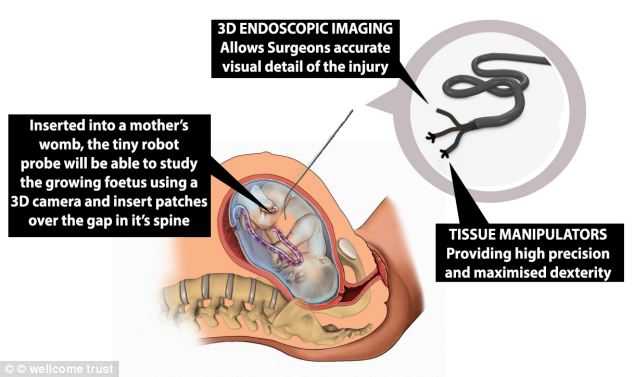
A graphic showing how a robot probe could work by photographing the foetus, allowing surgeons to operate

Surgery could be carried on the foetus, while still in the womb if researchers can develop the tool
Professor Sebastien Ourselin told the Observer: ‘It will be like a plaster. If we can do that, there will massive gain for the foetus while there will be little risk to the mother.
‘We are still in the design stage, so we could end up with a device with four or five arms in the end. Nor would it be used merely to put in patches. It could carry out delicate surgery or deliver stem cells to damaged organs.’
The condition spina bifida is caused during the first month of the embryo’s development.
Symptoms of the condition can include learning difficulties, paralysis of the lower limbs and incontinence.
Tiny £10m robot hand could transform spina bifida surgery in the womb
Source Mail Online